Saturday, March 3, 2012

Stairs Brainstorming

After exploring the stairs and becoming inspired from the neighborhood, I was reading to begin some more focused brainstorming


Stairs Brainstorming
------------------------------------------------------------------------------------------------------------------------------------------------------------

Goals
I intend to use the South Side Slope’s public pedestrian stairs as a venue for neighbors to asynchronously interact with one another, ultimately creating ambient relationships amongst neighbors and with their environment

Reoccurring Themes

  • Asynchronous Interaction
  • Ambient Play
  • Co-creation
  • Community Communication
  • Integration with day to day activities


1. Visualization
who is using the stairs now? When do people use the stairs?

2. Polls
What do people on the stairs think?

3. Trivia
Which set of stairs is smartest?

4. Community Board
Question of the day - What do people think? With answers from the previous day from each staircase

5. Community Stair Art
Chalk for people to draw on the stairs, maybe outlined before

6. Musical Stairs
Each stair is a musical instrument, Online recordings of the music people make

7. Stair Scavenger Hunt
Each staircase has an item to find

8. Ambient sound
Records the sounds of the staircases

9. Telephone between stairs
Staircases can call each other

10. Stair Photos
Weekly collages of staircase photos taken by passerbys with a fixed camera

11. Texting Game
Each staircase answers trivia questions or poll questions via text, get response with url to see answers

12. Jigsaw Puzzle Board
A puzzle people can work on as they walk by

13. Magnetic Poetry Board
People can create messages to interact with

14. Stair Pet
A mascot that wanders from staircase to staircase, like where’s waldo. people who find the mascot can send a photo text of it

15. Group Drawings
Boards that allow passers by to draw on them, creating a collaborative drawing

16. Asynchronous board games
Tic Tac Toe, Chess, Checkers, Crossword Puzzles, all played as a community

17.  Augmented Reality
Mobile game played on the stairs via smartphone

18. Stairs of Secrets
People can leave messages or secrets or wishes

19. Photobooth
People can get their photo taken on the way

20. Webcam of Stairs
Online surveillance of stairs

21. Communicate with the Stairs
From home, create sounds to be heard by people in


22. Stair Ad Libs
Ad Libs created by the stairs daily, next day read the results

23. Boardgames amongst Stairs
Passers by on stairs can play amongst eachother

24. Who’s there?
Stairs let people know what kind of activity goes on at the other end

25. Tweeting Stairs
Each staircase can have a twitter station where residents can express themselves however they’d like to

26. Stairs as Controllers
Each Staircase controls a digital mural that can be found online

27. Chatting Stairs
Chatting stations amongst stairs and online/mobile

28. Call the Stairs
Call a phone number and listen to the sounds of the stairs on the phone

29. Chutes and Ladders
Place slides around the neighborhood and play real life chutes and ladders

30. Slides next to Stairs
Encourage people to travel through the neighborhood by placing slides next to the stairs

31. Community Bulletin Board
Allowing Residents to self organize through the staircases

32. Trading Post
Take an item, leave an item

33. I Spy on the Stairs
With a Chalkboard, “I Spy With My Little Eye_______”

34. I Spy a ____ From the Top/Bottom of the Stairs
Motivate people to use the stairs so they can see what’s on the other side

35. Feelings Chart
People can circle how they feel on the feeling chart

Monday, February 27, 2012

Photos from the Neighborhood

I spent most of today exploring the neighborhood that will become my focus for this thesis project. I learned a lot about the users of these pedestrian stairs and experienced the staircases firsthand. Below are some photos from my explorations:


Friday, February 24, 2012

Establishing a Context

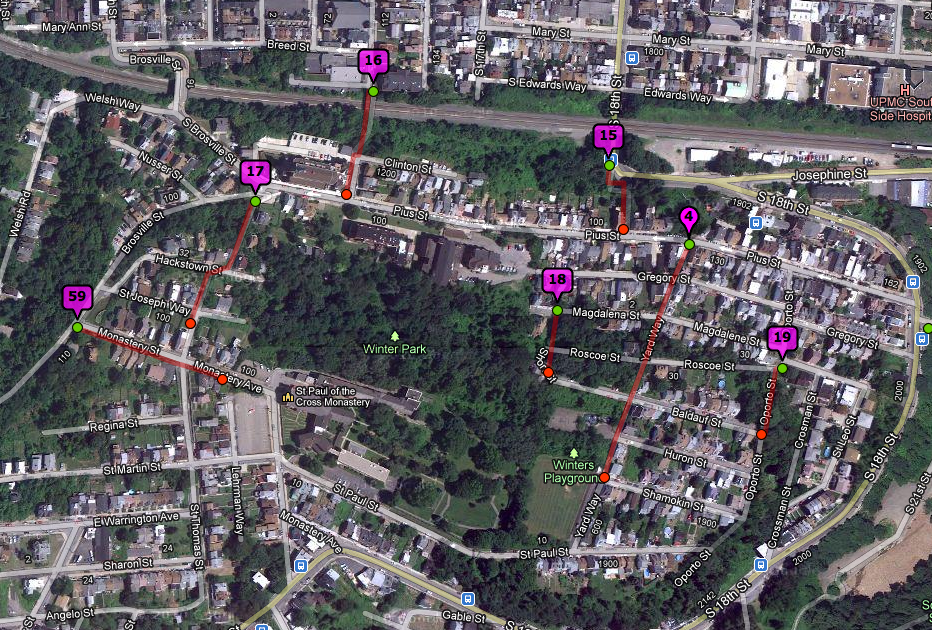
I finally discovered a final context that I am confident would make a great backdrop for my thesis: the public pedestrian stairs amongst South Side Slopes. I originally discovered this neighborhood when I noticed the amount of stairways in this area of Pittsburgh as visualized on http://www.communitywalk.com/pittsburgh/pa/pittsburgh_stairs/map/444504


Tuesday, February 21, 2012

Patterns and Infrastructures


 Today I wrote down some of the patterns I observed from my previous brainstorming. Overall I documented 7 patterns: 

  1. The project should encourage ambient play
  2. The project should be encountered in passing or by chance
  3. The project should utilize an existing infrastructure
  4. The project should ultimately strengthen a specific neighborhood 
  5. The project should have a bigger goal than simple play such as scoring, points, badges, achievements, etc.
  6. The project should encourage subtle mingling and person to person interaction
  7. The project should explore a mixture of low and high technologies


Thursday, February 16, 2012

Individual Thesis Meeting

Overall, my thesis advisor seemed happy with my brainstorming. One helpful piece of advice was to notice the patterns within my ideas, write them down, and try to create some new ideas following those patterns as guides. She also suggested I verbally express why I chose to refocus my ideas from person to person to person to physical environment interaction. I got some great advice that will definitely help in my next round of brainstorming.

Monday, February 13, 2012

General Brainstorming

From the readings I had done earlier this week, I was inspired to brainstorm some ideas of what this project can become. I've decided to use existing infrastructures such as bridges, bus stops, alley ways, door stoops, etc. as a venue for an ambient play project that connects residents with their neighborhoods.


Thursday, February 9, 2012

More Reading

With the advice of my thesis advisors, I have been reading up on more ambient philosophies on play. Some books I've picked up at the library are Homo Ludens by Johan Huizinga; Man, Play, Games by Roger Caillois, Rules of Play by Katie Salen and Eric Zimmerman, and Play Ethic by Pat Kane.


Homo Ludens has been my biggest inspiration. This book truly changed my perspective on play: What play is and how people interact with things playfully (we play more than people realize!)


Tuesday, January 3, 2012

Happy Holidays!

I've been taking a bit of a break to enjoy the holidays!
Happy New Years!

Tuesday, December 20, 2011

Friday, December 16, 2011

The End to a Great Semester!

Today's presentation went great! It was fun to see everyone's thesis posters and I received some great feedback. Here is a summary of the feedback:


Juror 1:
-seems to "blue skyish": why would everyone want to play a game?
-"community" needs to be better defined

Juror 2:
-Is it a game, or more of a playful activity?
-how will you motivate the users to participate?
-communities vary from place to place making the scope too broad; maybe there should be some general core issues that are adaptable to each location so it can be easily personalized
-for the next steps, try presenting the prototype as an enactment or narrative

Juror 3:
-what is the time scope? Will it be a long-term activity or an ice-breaker
-some commonality must be found; so far the demographics are extremely broad and could use more focus


Monday, December 12, 2011

Poster draft 2 Advisor Critique

This was my final practice presentation. Many of my peers' comments on the visual presentation were echoed by my thesis advisors, but overall everyone seemed extremely happy with the verbal presentation! I was extremely happy with the result of my presentation since I don't think it will be too difficult to modify the visuals.


Friday, December 9, 2011

Poster Draft 2 Critique

After presenting with my poster in front of other design students in my program, I received a lot of great feedback; however, at this point, the majority of the feedback was only about visual presentation, not content. People commented that the white space in the circles were extremely awkward and distracting; the asterisk in the center of the diagram was not noticeable enough; the abstract was too small and unnoticeable; the timeline was too heavy and distracting; the font was too faint. Overall it went pretty well, I was pleased with my work and it seemed everyone understood the content clearly and were satisfied with my argument.


Thursday, December 8, 2011

Poster draft 2

For this draft of my poster, I made sure to focus more on the main element of the overlapping circles, including more content within them. I wanted to address more serious issues to convince the viewer that this project is a legitimate issue.


Monday, December 5, 2011

Poster Draft 1

After presenting this to my thesis advisors, it was clear a lot of questions were left unanswered: Why is this a problem at all? How is this project significant? What exactly were the findings from the research? What do the word clouds mean, how do those words connect to each other? My advisors and thesis peers gave me much to think about for my second poster draft!

Sunday, December 4, 2011

Poster Brainstorming

I decided I would like to communicate my thesis by separating it into three areas of interest: Context (Boundaries of the final project: who, where, when, why, etc.), Community Theory (Why people need community, interview findings, etc.), Games (Mechanics, Game design techniques, etc.)


Friday, December 2, 2011

Overall Key Findings from Fall Semester

The Problem in a Nutshell:
Downfall in Community Participation, "Neighborliness", and lack of emotional attachment to one's neighbors and neighborhood


Effects of the Problem:
-Increased Crime rates

-Decreased Participation in Politics and Community Volunteering
-Lack of Community Organizations, Weakened Relationships


The Root of the Problem:
-The invention of the car (people's abilities to travel farther faster)
-Women in the workforce (increased pressure to spend more time working)
-Advancements in entertainment technology (television, the internet, and other isolating activities)


Resident Interview Findings:
-4 Main Types of Neighbors: Community Activists, Social Butterflies, Polite Reserved Neighbors, Shy/Detached Neighbors
-People are afraid of their neighbors, yet they are looking for ways to meet people and to connect with one another
-Feeling attached to one's physical environment leads to emotional attachment to one's neighbors


How Games can Make a Difference:
-

Friday, November 25, 2011

Revised Feedback Session


I've gone through each scenario and prepared it for the research session. Next steps: Create the prototypes, recruit participants, and make appointments!


----------------------------------------------------------------------------------------------------------------
Scavenger Hunt Race

Main Feedback
    • Would people want to collaborate with their neighborhood if they shared a common enemy (an other neighborhood)?
Prototype
    • List
    • Flyer
    • visualization of data
Process
    • Show Flyer, Would you want to participate? Why?
    • Show List, What if it were things you find in your everyday routine?
    • Show Visualization, Would this encourage you to participate more?


----------------------------------------------------------------------------------------------------------------
Guessing Game, Who’s the Neighbor?

Main Feedback
    • If people were paired up by a system, would they be likely to start a conversation or even a friendship?
Prototype
    • Letter
    • Catalog
Process
    • Explain game
    • Show Catalog, Would you want your profile to be included in this?
    • Show Letter, Would you want to learn more? Would you keep up a conversation? Would you feel comfortable becoming friends? What would you write about yourself to someone?


----------------------------------------------------------------------------------------------------------------
Fill in the Blank Puzzle

Main Feedback
    • Do people respond better and participate more within their community if events, neighbors, and businesses were personalized and well visualized?
Prototype
    • Visualization Before (empty)
    • Quiz of all of the businesses and people you would like to get to know
    • Visualization After
Process
    • Show Visualization after, explain tool
    • Show quiz, Would you want to learn about new businesses that you don’t use?
    • Show visualization before, What would you put on your map? Would this be useful for businesses? People? Events? When would this be useful for you?


----------------------------------------------------------------------------------------------------------------
Ice Breaker

Main Feedback
    • Would people talk to each other if they are given the proper cues?
Prototype
    • Screen Notification
    • Photo and Quest screen (have 5 quests for participant to choose from)
Process
    • Show Phone and explain it’s a mobile app called ice breaker that helps you meet neighbors who are near by
    • Show notification, If you were at a cafĂ© and received this notification, would you want to learn more, or would you ignore it?
    • Show profile and quest, Would you follow through this quest? If not, what kind of quest would you follow? Would this be fun? Would you feel comfortable meeting someone this way?

----------------------------------------------------------------------------------------------------------------
Scoring Mechanism and Rewards

Main Feedback
    • Do people need a realistic motivation (i.e. money) to encourage them to play games?
Prototype
    • Points or Tokens
    • Gift Certificate, split in half
Process
    • Explain the game has already been played
    • Show Tokens, Would you want to exchange these for a gift certificate?
    • Show gift certificate, Would you want to use this even if you were required to share it? Would you go out of your way to not share it (selling it, paying the other neighbor off, etc.)


----------------------------------------------------------------------------------------------------------------
Collaborative Construction Game

Main Feedback
    • Would people bond by building something together? Do people want to help out their community if the opportunity is presented to them in a fun way?
Prototype
    • Image of color by numbers mural
Process
    • Show image and explain task
    • Ask if they would like to participate, why?
    • Ask what other construction is needed in their neighborhood
    • Ask if this should be turned into a game, with points or some kind of reward

----------------------------------------------------------------------------------------------------------------
Community Portal

Main Feedback
    • Would people want a virtual space where they can communicate and self-organize as a community? What do people want to make public to their neighbors?
Prototype
    • Conceptual Model 
    • Unfinished profile
    • List of Features (each feature on a different post-it
Process
    • Show conceptual model, explain concept
    • Show unfinished website and list of features, Which features would you like to see in this community portal?, Why?
    • Show unfinished profile, What would you feel comfortable putting on your profile and making public to your neighbors?
    • Would you use this if it were a new website? If it were a platform on Facebook?

----------------------------------------------------------------------------------------------------------------
Notification System for Short, Low Commitment Games

Main Feedback
    • Would people be more motivated to play games if they received weekly triggers or reminders to do so?
Prototype
    • Calendar
    • Phone Notification
    • List of games (Turn everyday into games)
Process
    • Show calendar, explain concept
    • Show examples of games, ask if they would likely participate
    • Show phone notification, Would they respond? Ignore? Would they pass it off as spam? How often should they be notified? (what’s not too much or too little?)

----------------------------------------------------------------------------------------------------------------
Ludic Distraction for Ambient Familiarity

Main Feedback
    • Would people be likely to introduce one another if there were an interesting conversation piece? Would people feel safer or more attached to their community if they recognized their neighbors?
Prototype
    • Table top 
    • Screens: bubbles, Tic-tac-toe, choose game screen
    • Map with placement of table tops
Process
    • Show map, explain concept
    • Show bubble screen, Would you want to interact with this?
    • Show video capture of neighbor, Would you continue playing if you could video chat during? Would you feel safer in your neighborhood if you recognized most of the people who live around? Would you want to start a conversation with that person?
    • How would this work in different contexts?